
Global Development Delay, Then What?
I struggle without a plan, a schedule, or information. That’s exactly where I’m at with Nasirs Global Development Delay diagnosis. We are getting to a point of contention or a bottleneck where we are playing a guessing game of what Nasir does or doesn’t understand. We’re at a critical time in Nasirs development and we need answers, or at least a direction.
I unintentionally took a year off sharing updates or general life wins. We have our own business which has been full-on, but we’re still trying to balance that and parenthood. We’ve left ourselves behind and I haven’t been able to share our story as it happens. But I’m here now, as sporadic as it may be. There is a lot to highlight when it comes to the ever-growing needs of a child with GDD, as they reach different stages of their lives.
What Global Development Delay Actually Means (And What It Doesn’t)
From our initial results, we were told Nasir would have this umbrella diagnosis until he turned eight. He would then be reassessed to a formal condition. Nasir turned eight at the end of last year and we still only have the label of Global Development Delay. No other firm or suggested direction on how we can best support him.
Many parents I’ve talked to or seen in groups report that, from the assessments, there is already indications of Autism, ADHD, or Intellectual Disability. This gives them something they can use when discussing support from government agencies, schooling, and family or other carers. People are more understanding when you can give them something they are familiar with.
Not Nasir. Global Development Delay is simply that. What does it even mean? It’s a very broad term that encompasses so much but means so little to people who aren’t living through it. The conversations I feel I have to have with others, explaining Nasir’s behaviour when he’s upset or otherwise, are always long winded. Mostly because I’m effectively guessing what is going on for him.
Still No Diagnosis at 8: Living in Limbo
At last year’s pediatrician appointment, we explored autism and ADHD. The Doctor provided us with the short ADHD questionnaire (Rahim has been through a thorough assessment). Nothing jumped out to the Doctor to point to ADHD. We discussed autism, as people like to box him in with this, it’s easier for them to reconcile his behaviour or quirks. This wasn’t something she was seriously considering at this stage. Even though it’s a spectrum, if he is autistic, at the time of the appointment, he’d be very low on the spectrum. So, Global Development Delay it is. At seven, I get it.
And if it is an Intellectual Disability? We would have to get further assessments. More waitlists. drawn out delays. What’s more, the annual check-ins aren’t on a 12-month rotation, those waitlists are becoming larger too. Hopefully they will know what they’re looking for at our next appointment and be referred for a MRI brain scan. In my opinion, he should have been placed on a waitlist for assessments from that point to get the ball rolling.
So, when does Global Development Delay become another diagnosis? At eight years old, we are still waiting.
Being in limbo really sucks. As Nasir approaches his tweens and teens, he will be developing in other ways. Puberty is just around the corner. You remember what it was like? Confusing, exhausting, and just hard? It is daunting to try to help him through this when he won’t be able to understand what is happening. I can’t explain it to him or give him the answers.
I will be getting more into that, but for now, here’s a present look at how Nasir is doing.
Development Progress: The Wins We’re Seeing
Over the past year Nasir has truly come into his own personality. Showing us who he is and who he could become. There has been a lot of building on what already exists, it’s exciting. A happy demeanour, he looks after Aisha, helps Rahim learn, and loves being around family. There are sprinkles of human moments and emotions, including wanting some alone time – I don’t blame him. The ‘WHY?’ stage has also entered the chat…
Interests That Are Helping Him Learn and Engage
We have had to force him out of his comfort zone; like going to the cinema. He really didn’t want to go, would have rather stayed at home on his device. Until the Minecraft Movie started and his eyes transfixed.
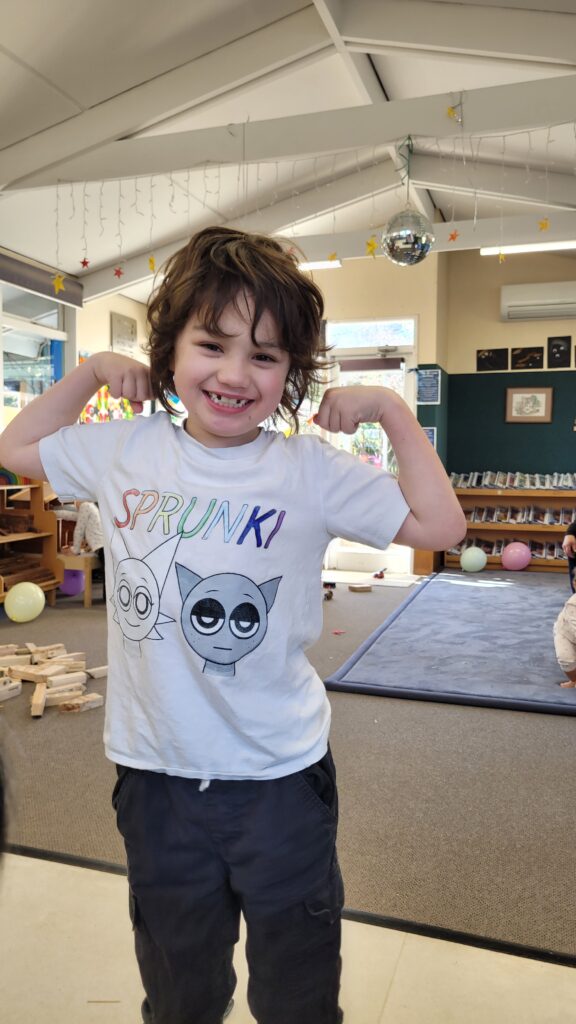
He has expansive interests.
- Pokémon has become HUGE in our house. Nostalgic for me, as a 90’s baby.
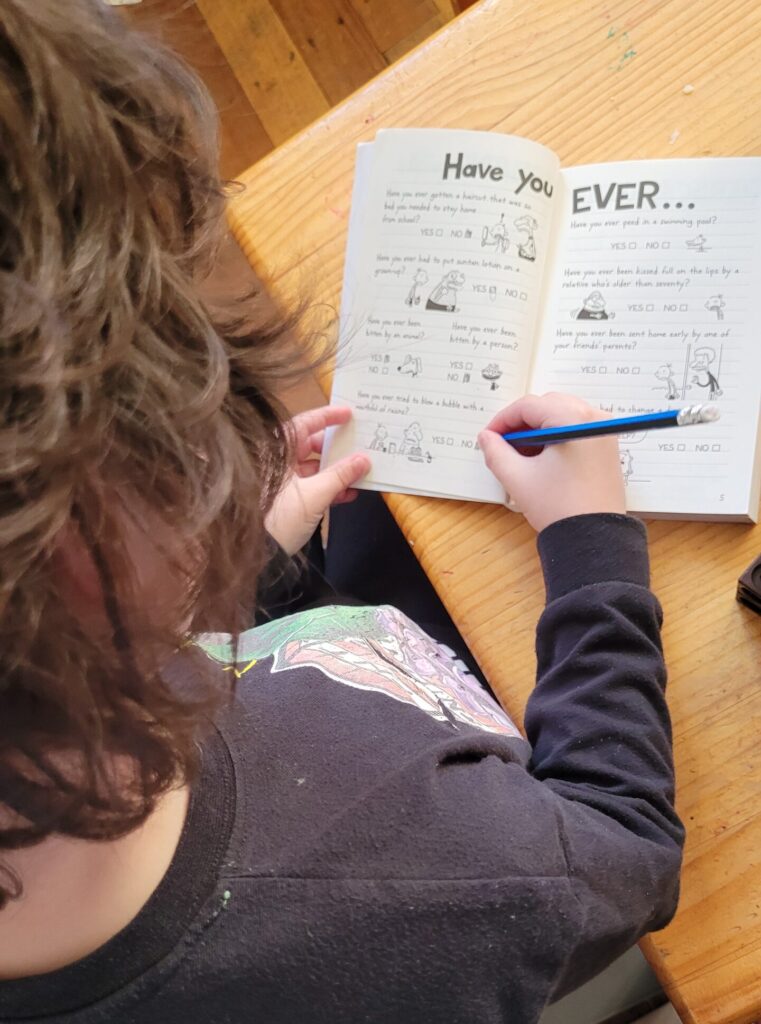
- Dog Man & Diary of a Wimpy Kid are still king for reading but I am doing my best to diversify
- He loves a comic format
- Tandem Roblox with Rahim
- Now blocked and replaced by tandem My Singing Monsters
- K-Pop – Of course Demon Hunters but the actual music genre too.
- We love Jung Kook
Music is big in our house. I love Mariah Carey, naturally her new album has been a staple since its release. She did a cover of Paul McCartneys ‘My Love’ which the kids love to sing along to, especially Aisha. We were in Whitcoulls, hunting down Cat Kid Comic Club books and Paul’s original version played in the shop. Nasir immediately recognised the lyrics and the sound of the music. I was proud because:
1 – He pays attention to Mariah
2 – He’s never heard Paul’s version but still identified the same.
I think Nasir is quite onto it, but this is a moment of progress, showing his cognitive skills are developing.
Communication Progress and Finding His Voice
This is just a few and oftentimes I use them to convince him to complete his tasks. Nasir is also confidently verbalising his feelings, emotions, opinions, and views. He’s able to speak up for himself, which is helpful when others may not be telling the entire truth so they don’t get in trouble (I’m not looking only at Rahim hahaha). This is great to know the needle is moving in terms of having the vocabulary and cognition to support expressing himself. Previously it was just pointing and telling me “(name) did it!”, now we have context or details.
Goals (And What’s Actually Working)
At the end of 2024, I listed a few goals I wanted to support Nasir achieving. They’re fluid goals because we need to be flexible, patient, and understanding that he is doing his best.
Level: Unlocked!
- Can say Buster Moons phrase “Dream big dreams” instead of “Big dreams big dreams”
- This means he’s thinking about what he wants to say before he says it.
- Pronounces ‘F’
- Yes, that does include using THE ‘F’ word! Progress. Cool 😬
- He was ready to learn – Which is the most important to remember! Kids aren’t interested until they’re ready
- The many faces we’ve made together trying to make the right sounds
- (Yesterday he read ‘fucking’ while looking at some reel on my phone – was I proud that he pronounced F properly and could read the word? Yes! Was I equally shocked he said and could read the word? Also, YES!)
We’re still working on it!
- Establishing boundaries with tablet use
- A robust routine teamed with Googles Family Link works
- So does removing access to Roblox
- Understanding the importance of his medicine
- This is a losing battle – See below…
- Creating a smoother home-to-school routine
- Work in progress – More on that too…
- Better understanding of responsibility over his belongings
- I have stopped counting the many hoodies or jerseys we have lost. I’m not looking forward to winter setting in.
Emotional Development in Children With Global Development Delay
Nasirs emotional awareness is absolutely flourishing! He recognises when I am triggered and emotional, and does his best to calm me. I’m not talking about just coming up and giving me a hug then calling it a day. He actively approaches me, a wild beast, soothes me by saying he wants to give me a hug, reminds me I need to calm down and breathe, and squeezes me. It’s grounding and beautiful. I always make sure I apologise for my irrational behaviour and explain the feelings behind it. To me, it is important for my children to see and understand that feelings are real and valid but behaviours should be worked on and expressed in a non-harmful way.
The Reality of Global Development Delay: What We’re Still Struggling With
There are some areas, though, that we are constantly working on.
For example, Nasir is still medication adverse. So much so that he ended up in hospital last year. I have never been so scared in my entire life, and there’s no doubt that he was too. I will write about this, separately. For now, it reiterated that Global Development Delay is a placeholder. What’s a better reminder than explaining to each medical personnel as they enter the room about Nasir. The challenges he faces and the reason why he ended up in hospital. The challenges we face and feeling defeated because we don’t have any answers. Other than, we’re waiting on further appointments, assessments, and information.
He lives with Global Development Delay. Just that. We don’t know anything else. We’re still waiting. He is still struggling and needs extra advocacy.
“You Want a Punch? Then Behave!”
That heading is something he had begun using too often. I’m not sure where he got it from but he’s coming to understand his behaviours. Nasir likes to throw hands, kick, or push when he’s heightened. Expresses stubbornness and pushback when he’s adamant he won’t be doing something. This is normal development, for sure, but Nasir and Rahim are seemingly going through it at the same time. Fun. The difference is, I can reason or talk to Rahim about it. Whereas Nasir needs to be alone in his room until he calms down, otherwise he gets physical. If he hasn’t already.
Once he does calm down and think about his actions, Nasir will seek out who he’s possibly hurt and apologises. He knows he can say sorry for something he couldn’t wrangle during an outburst. Being loud or throwing hands is something we can work toward expressing in a healthier way. To clarify, he only hits at home. At school, the worst he’s ever done is push but not to harm. I’ve been told.
As I write this, I realise we need strategies for both of us to regulate.
His teacher from last year was touched when he actively sought her out to apologise for yelling at her one morning. Clearly, he felt bad about it and knew she was trying to ease the transition from home to school.
School Refusal and Anxiety in Global Development Delay
Returning to school this year has been a point of contention, most mornings. From the moment I announce that it’s time to go to school, Nasir expresses his unwillingness to leave the house. He physically refuses to get out of the car or enter the school grounds. He cries on the other side of the fence, sometimes chasing my car by the fenceline as I drive away to take Aisha to kindy.
Once I am gone and the school have responsibility of him, Nasir sits outside, rejecting any of the educational staff. As I mentioned before, he has yelled at his teachers. The school caretaker does his best to encourage him to class as his teacher cannot dedicate half a morning to rounding him up. Thankfully, the caretaker has built a relationship with Nasir over the years. He knows how to manage Nasir, and I feel safe leaving my boy with him.
I have tried to walk him into class on separate occasions. Always resulting in him crying or following me out. I remember a request to do my work at school so I wouldn’t be leaving him.
While morning drop offs have improved, this happened for most of term one and I fear regression after school holidays. The prolonged period off the school routine will have a negative impact. I am dreading term two. Seeing Nasir in distress every single morning is emotionally exhausting. Having to manage his emotions, explain to him that he needs to go to school, organise Rahim and Aisha, do my best (and failing) at remaining calm, and shuttle everyone into the car all the while being yelled at by an emotionally charged Nasir. It’s a lot.
I try to reason with him by saying the government will put mummy and daddy in jail if he doesn’t go to school. His reply? “GOOD!” Apparently that’s where we belong for the seemingly criminal act of sending him to school in the first place.
I have to admit, sometimes jail sounds like it could be a holiday. I digress…
Building Support at School: What’s Actually Helping
I commend his new teacher. She is a fresh face to the school and hasn’t had the opportunity to know Nasir prior to teaching him. Through the ups and downs of Nasirs emotions and actions, she has managed to build a ‘solid’ relationship with him. I’ve shared his interests with her which she had incorporated into his day like offering him Pokémon colouring pages in the first 10 minutes of his day. To coax him to class around the time of the bell, she rewards him with stickers that he gets to put on his lunchbox. He loves it.
The first day back was somewhat traumatising for him. He had trouble adjusting after the long holiday period and didn’t want to be in his new class. After finding his teacher from last year, he stayed with her, creating his My Singing Monster characters or vehicles with the connecting cubes. The new teacher quickly identified he needed something to help him regulate and enjoyed certain activities. ‘Nasir’s Box’ was immediately established.
Nasir’s Box contains:
- Connecting cubes
- Activity workbook
- Books (Last years teacher kindly gifted him Captain Underpants & some Minecraft books)
- Colouring pages & pencils
He gets this throughout the day, when he might be having a hard time or needs a quiet activity.
Strategies That Didn’t Work
The school principal was aware of the struggles Nasir was experiencing, having had her own interactions with him. We had a meeting toward the end of term one with his teacher to discuss how to best support Nasir and understand on what’s going on. It wasn’t only refusal to go to class and possible anxieties about it. Sometimes he wasn’t doing or completing his work, wandering off and not coming back (yup, seems like he’s still doing that), or not getting back to class on time.
We discussed strategies, Nasir’s home and school routines, his behavioural shifts, and how I felt he was doing in general. The ideas we explored were:
- Gamifying all of his work
- Not a reality
- Giving him a laptop for everything
- Again, not possible
- Providing a device for 5-10 minutes after he returned to class
- This would be to coerce him into class. Presents problems; you’d be prying it out of his hands and risking an outburst.
I shared that we are still sitting waiting for our next pediatrician check-in to move on from Global Development Delay. This is important to bring up because when he was first categorised as globally delayed, they measured his skills with approximate ages. Since then, he’s clearly advanced but to what age? How can we inform his teachers where to meet him if we don’t know, ourselves? All the medical updates we get are generally shared with the school, but it has been some time…
The Support Plan That We’re Using Now
This was a much-needed meeting to really delve into the situation as a whole. Getting the home/school/medical picture platformed the strategies that would be encouraging for Nasir, meet him where he’s at, and ensure he has firm boundaries and expectations in place for his education.
Here’s the strategy that was agreed to:
School
- Establishing and affirming routines and expectations within the classroom
- Visual routine chart
- This provides Nasir with routine, expectations, and visual reminders which he responds to
- Continuing with Sticker rewards
- He gets a sticker for certain actions decided by the teacher
- I provided some Pokémon stickers for extra encouragement
- Tokens
- He would get to choose an option given by the teacher at the end of the day
- For the bigger tasks: finishing his work
- Each token is worth 5 minutes
- At the end of the day the total number of token minutes equates to a chose reward
- Book
- Game
- Device
- Drawing
Importantly, anything done at school will be mirrored at home and vice versa.
Creating Consistency Between Home and School
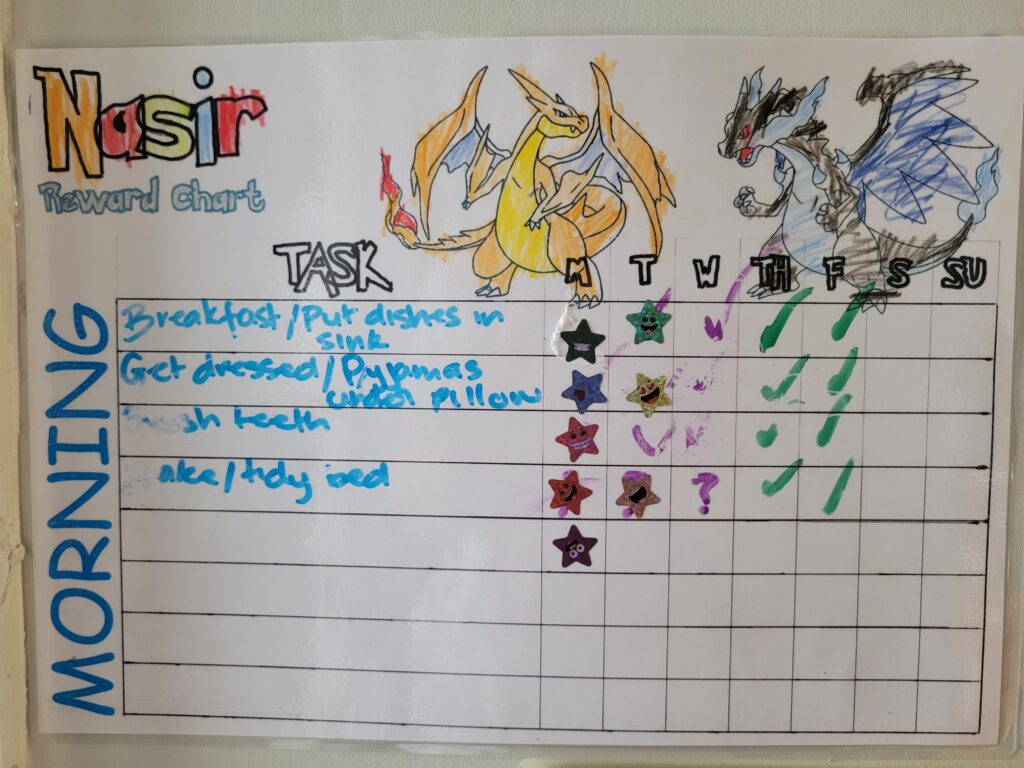
During the Christmas/New Year school holidays, we created sticker charts that didn’t get used properly. Now is our time to put them to work to create the synergy between home and school. This has been mostly effective as throughout daycare and school there has been a consistent philosophy – Do this, then get that. Effectively, this is what both of these reward systems encourage.
We have sticker charts for morning, after school, and evening. Here’s our system:
- Star stickers ⭐ or ticks (whichever I have the energy for) for individual task completion
- Make bed, brush teeth, bags away, tidy bedroom, etc
- Pokémon stickers for weekly completion & extra tasks
- At the end of the week, if most of the chart is complete, a tally chart adds up to another award
- It could be a book, a toy, or something they’ve been wanting that we wouldn’t normally purchase – all within reason
- I have only now figured out how to set up a Family Payment Method through Family Link so we can now purchase educational apps for them! (the absolute power at my fingertips is consuming)
- Extra tasks are changeable but currently:
- Listen – Do it the first time
- Use words not noises
- Share something you like about yourself
The kids get excited for stickers and having visual reminders gives them something tangible. Out of sight, out of mind is real. Especially for children.
Global Development Delay and Puberty: A New Layer of Challenge
I also think we are at an intersection where I believe he is starting puberty. This raises questions of are his behaviours at a specific age level or are they due to puberty or is it both – Can you imagine that double whammy?! If things don’t go Nasir’s way, yelling, hitting, and tantrums ensue – mostly aimed at whoever has upset him. Generally, that’s me. At this stage, I’m unsure if it’s normal for his age, wherever he’s at developmentally, or if it’s puberty that’s the cause. Maybe it’s all colliding at once? I’m looking into it and will share what I find.
Supporting Siblings of a Child With Global Development Delay
Little Rahim, who is going through his own developmental milestones which include a sprinkle of rebellion or answering back, is still getting the explanation of ‘Nasir’s still learning’. It’s true, but Nasir’s situation deserves more nuance than we can give Rahim. It’s frustrating for him. For the moment, I defer to Nasir’s brain working a little different to his. I see him conceding like he understands, but it’s what he keeps getting as an answer. The upside of it, Rahim uses ‘they’re still learning’ for other children he sees as similar to his brother in terms of behaviours or quirks. We do use it for his sister, when she annoys him, and even for him. He understands the different contexts.
Rahim needs the space and time to explore and develop in his own ways without having to constantly be mindful and wary of his brothers’ moods and potential hitting. At almost 6, he’s very understanding and loves to have those conversations, but I wish he could just be a child.
That’s Not All Folks!
Because it has been a while, there is much to share.
- Housing modifications – Yep, we went through that process
- Dental ‘surgery’ – This is coming up
- Hospital adventures – How an “undiagnosed” condition mixed with a flu that shut down the school
- Puberty & Global Development Delay – it’s on it’s was and we need to be prepared
- Interest / adventure updates (and how we utilise them
to controlas aids) - Bedtime winddown routine
Considering it may be some time in between posts; I will try to put effort into Instagram to share more in the moment moments. For now, I hope this wasn’t too much of an information dump but gives you a picture of where we are currently with Charizard, formerly known as Nasir. Ever patient, desperately waiting.
Sorry it’s been so long,
Elysha 🚀