
Meeting Our Speech And Language Therapist
I have absolutely no idea how Speech and Language Therapy was run in a pre-Covid-19 world, but let me tell you, post-Covid-19 was not as I expected it to be. Of course, throughout lockdowns, it was all on me as was any of the work when Nasir was at home. I had thought that there would be more visits during daycare and really working with the children struggling with speech, but it seems that wasn’t the case.
Look, I know with children in general, if they want to play, they’re not going to sit down with someone they don’t know and practice speaking but then there are children that face similar issues as Nasir, that don’t exactly grasp the concept as they don’t 100% understand the instructions. If you tell him he needs to sit down and learn or identify words and/or the meaning of them, he’s going to do whatever the heck he wants to do. So, I get it, but I did expect it more of a focus due to his additional needs. As previously mentioned, our SLT was through the Ministry of Education and not a private (paid), so there could be quite a difference between these different options but being naive and inexperienced as a mum, as well as having a child with additional needs, I didn’t know what was available to my son and I had no guidance or support to tell me otherwise.
This is not to say that I am disappointed. I am very grateful for the support of someone that has the knowledge that I clearly did not have. I could only apply techniques I knew worked for me because, to this day, we still don’t know how Nasir’s brain fully works or if there is going to be ongoing support needed for him. As time goes on though, it’s been easier to weave into Nasir’s learning style which only strengthens with the more he is able to understand, but the foundation was built with the experience and guidance of our SLT. It all starts in the home, and I am glad that it fell to me, his safe place.
Therapist Communication.
Getting the call that we would FINALLY be starting, this is what we had been waiting for!! The support from our SLT was through Zoom meetings, emails, and whenever she was able to safely visit daycare. She was knowledgeable and made needs-based judgements with the information we gave her, conversations with daycare Teachers, and any observations she made when she had contact with Nasir. Whenever we would meet via Zoom, she would send a follow up email of a summary regarding what was discussed, any resources for more context and guidance, and homework or goals to work on between sessions. If she had visited the center and observed Nasir, we would receive an email to let us know along with any important notes or progress. This type of communication would later help form our decisions over schooling for Nasir.
How Our Speech & Language Therapist Opened Nasir’s World
Okay! Let’s talk about the support, the guidance, the help! We explored many different strategies, gained a lot of resources, and perspective with our first SLT, which was who we had during Nasir’s last year at daycare. It must have been after our second meeting (according to our emails), it was suggested to come up with a phrase that Nasir would be able to frequently use that would encourage him to start stringing his singular words together. Something I considered that would be easy to work on would be “Can I have more _____ please?”
When children are just learning to construct sentences, some of the best advice out there is to be modelling phrases just above their level.
MOE Speech & Language Therapist
If Nasir is using single words, we can help him by commenting using 2-word phrases. Once he starts joining 2 words together independently, we can start using more 3-word sentences with him and so on.
It’s great that you’ve picked some functional phrases to work on repeating a lot. “Can I have more _ please?” sounds like a good one, but there are quite a lot of words in there. I wonder if it would be easier for him to pick up if you shortened it to “More ?” or “More __ please”.
You have no idea just how much this CHANGED THE GAME for us! I mean, obviously there was a lot of work that went into him getting the phrase down. There was a lot of prompting him to use the phrase, plenty of modelling and repetition to pronounce the words relatively well, and there was also the teaching of words he needed if he didn’t know it already. This was a big sentence I had tried to encourage any time we were eating. You see, the way we originally knew if Nasir wanted food was that he would physically take us to wherever the food was which progressed into coming up to us and yelling “YUMMY YUMMY YUM!” with the food he wanted to eat and passing it to us, so the opportunity to go a step further with this phrase was for him to use words he already knew and show him how to use them in a way that he may be able to understand. Eventually something like “More DRINK please” turned into “More MILK please” which then got us working on the longer question above “Can I have more _____ please?”.
If you’re interested in reading research about modelling, have a look at: Speech and language therapy interventions for children with primary speech and/or language disorders
The intervention technique: Speech and language therapists commonly use a range of behavioural techniques, including imitation, modelling, repetition and extension. These draw the child’s attention to the structure and the content of the speech or language input (or both), and the input is often presented at a developmental level a little ahead of that of the child. Stimuli are commonly repeated many times to draw the child’s attention to the correct form. It is assumed that practice is one of the cornerstones of reinforcement and that repetition makes it easy for the child to learn what they have not otherwise acquired. Key to all intervention is building the child’s motivation to speak.
James Law, Jane A Dennis, and Jenna JV Charlton
The Positive Impacts.
If you had to sit down and think about how this effects a child that struggles with communication, what would you come up with? This SIMPLE phrase opened his world by giving him a voice to tell us what he wanted, what he needs, and be understood. From here, Nasir stopped acting out of frustration and anger so much because we were able to respond to what was clearly making sense in his head but wasn’t coming out in intelligible language. Gosh, imagine being trapped inside a body you’re newly discovering, not able to voice your thoughts, and what you do manage to communicate, people get totally wrong, or you’re left completely unfulfilled. I’d be pretty frustrated and act out on it too. You can probably now understand why this was such a game changer for us as a family. It was incredible. Our big boy was making meaningful and massive leaps in his communication, who am I kidding, all the progress he makes, be it a new word or better pronunciation, is ALL massive and meaningful. Not only that but we had a very developmentally advanced 2-year-old that was watching, absorbing, and using the tools we were implementing with Nasir, so as Rahim (the aforementioned 2-year-old) was learning to speak it was inadvertently helping Nasir as he was hearing proper speech and conversation more frequently. The relationship between our two boys has always been special, learning and teaching each other, with both taking turn at older and younger brother duties where appropriate.
5 Tips to Support and Encourage Your Child’s Speech and Language Development
I don’t know about you but when it comes to taking notes, I’ve never been good at summarising or seeing the keywords to record which means I usually type everything word for word and get lost really easily so let’s breakdown some strategies we used to build up Nasir’s language skills.
- Use Simple, Functional Phrases
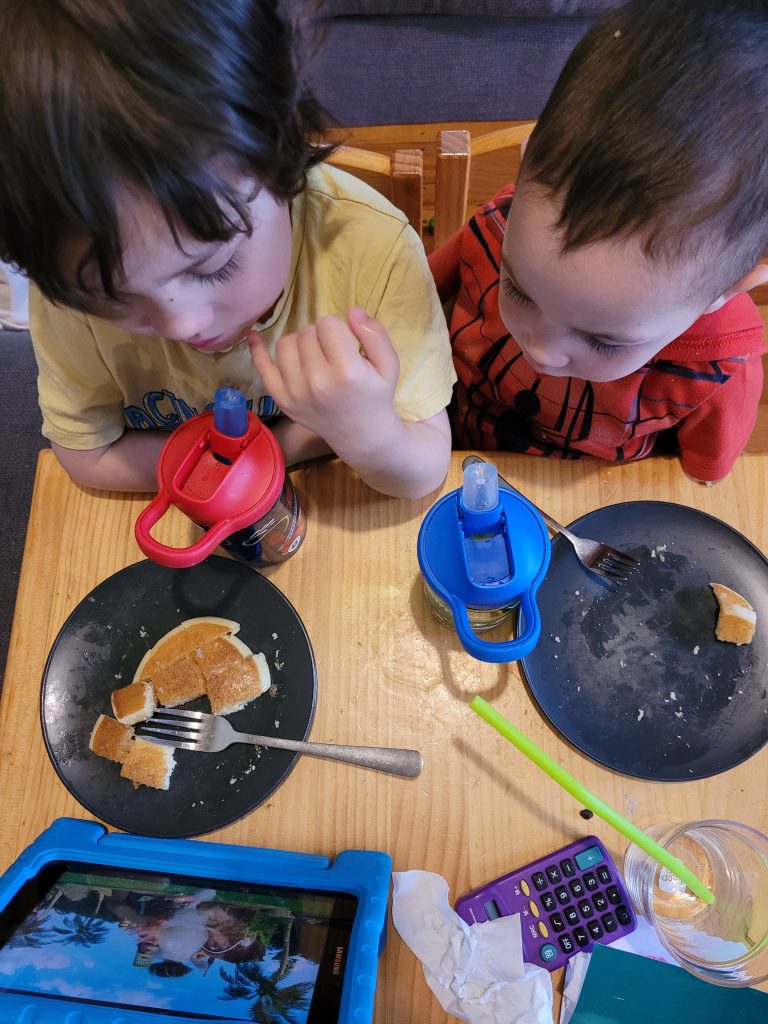
Start with basic, functional phrases your child can easily understand and use. For example, instead of a full sentence like “Can I have more pancakes, please?” begin with “More pancakes, please.” Gradually increase complexity as they get comfortable, moving from single words to two or three-word sentences. - Model Language Just Above Their Level
If your child is using single words, model two-word phrases for them. Once they start joining two words together, you can introduce longer sentences. This helps children build their language step by step, making it easier for them to grasp new structures. - Repetition and Practice
Consistent repetition is key. Encourage your child to use the target phrases frequently and model the words for them. Reinforce their efforts by responding to them with praise and repeating the phrase correctly to solidify learning. - Create Opportunities to Communicate
Offer situations where your child can use their words. For example, if they want food or a toy, prompt them to use the phrase, “More __, please.” Make language part of daily routines to help them connect words with actions. - Positive Reinforcement and Patience
Celebrate even small progress, as any improvement is meaningful. Frustration can build up when communication is hard for your child, so being patient and supportive helps build their confidence and encourages them to keep trying.
By incorporating these strategies, you can encourage your child’s language development in a supportive, structured way that meets them where they are and helps them grow.
It goes without saying, there was much more value offered within our sessions that we worked on at home to support Nasir that have all contributed to getting his speech and language to where it is today. It’s funny reflecting on the information I was given, it didn’t seem like much at the time, and I had no idea if there was much impact likely due to being so overwhelmed with our situation and feeling so drowned in what was going to be an intense and long journey.
The resources supplied by our SLT met where Nasir’s language skills were and suited the needs of his development. With this in mind, I will share what we worked on, how we implemented these, and if there was meaningful impact on Nasir.
As always, thanks for being here,
Elysha
You are amazing, I wish you felt you could’ve spoken with me more on your feeling and life issues. You have always been a very special person in my life, not just because we’re related but because if our up bringing.
I will always be there for you and your family.
Thank you, aunty. I feel like I don’t have time to even breathe some days, let alone express the intricacies of our situation or the complex and polarising emotions I have. <3