
Goal Setting: Mastering the Next 12 Months
Life can feel overwhelming when you’re managing responsibilities like health, family, finances, and personal growth. I have struggled with my identity as an individual and as a mother but have made the decision to make this my big goal for the year.
I have so many notebooks scattered around my house that had random routines and goals for the year, but it all looks like a mess. Not only does it annoy me that I’m wasting all these pieces of paper that make no sense, but there’s no structure, no direction, and no clarity to ensure these are easy to stick to. I have found it so hard to reflect and review, create a flow or relationship between goals, or even see a full overview of my goals when it’s across pages I can’t even find.
Goal Setting with Professional Framework
But what if you could apply the structured frameworks used in professional settings like ITIL, Agile, and SMART goals to make personal goals easier to achieve? It wasn’t until I started using ITIL, Agile, and Kanban boards in IT and did a full 12-month goal planning with my team, that it all finally clicked for me.
To make this approach more relatable, I replaced Agile terms with simpler ones for personal goal setting. I’ve often found myself scratching my head when people talk about reverse engineering goals because it doesn’t make sense to me so I switch off as my brain has decided it’s too hard to get my head around.
| Agile Term | Simple Term | Description | Recommended Timeframe | Recommended Amount | When to Create |
|---|---|---|---|---|---|
| Epic | Big Goals | Overarching goals that represent your priorities. | 6–12 months | 2–4 (e.g., health, family, home) | At the start of goal setting |
| Feature | Focus Goals | Specific goals feeding into Big Goals. | 1–3 months | 2–3 per Big Goal | At the start of goal setting |
| Story | Actions | Measurable and actionable steps to achieve goals. | 1–2 weeks | 10–12 active at a time | Set during goal setting and as you progress |
| Sub-Task | Steps | Small, immediate tasks that move you forward. | Instantly gratifying | 3–5 per Action | As you determine Actions or realise additional Steps |
This guide introduces a methodical yet flexible framework for goal-setting and execution. Whether you prefer a quick start or a comprehensive approach, you’ll find the tools to create balance and sustainable progress.
Quick Start Guide: Your Framework in 5 Steps
If you’re feeling overwhelmed, this guide breaks the process into manageable steps to get you started right away:
- Reflect on the Past Year
- Look back on what worked, what didn’t, and the lessons learned.
- Example Prompt: What habits helped or hindered me last year?
- Define Your Vision
- Write down your big-picture goal for the year—the “why” behind your efforts.
- Example Vision: Improve health and well-being.
- Break Your Vision Into Big Goals (6–12 Months)
- Identify 2–4 categories of your life that will have the biggest impact on your Vision.
- Example Big Goals:
- Health and Fitness: Build sustainable habits.
- Household: Create a stress-free home environment.
- Set Focus Goals for Each Big Goal (1–3 Months)
- Choose 1–3 goals for each category to work on over the next quarter.
- Example Focus Goal: Build a consistent exercise routine.
- Create Actions and Steps (1–2 Weeks)
- Break Focus Goals into specific Actions and smaller Steps. Work on 10–12 Actions at a time, and adjust as needed.
- Example Action: Explore Cardio Options.
- Steps:
- Look for walking tracks nearby.
- Buy comfortable walking shoes.
- Plan walking sessions on your calendar.
- Steps:
How to Stay on Track
- Celebrate Wins: Acknowledge small milestones to keep yourself motivated.
- Track Progress: Use a Kanban board or notebook to manage tasks in “To Do,” “In Progress,” and “Done” columns.
- Reflect Regularly: At the end of each quarter, evaluate what’s working and make adjustments to your goals or actions.
Step 1: Reflect on the Past Year
Reflection is a crucial first step. It helps you identify patterns and focus on what truly matters, aligning with ITIL’s “start where you are” principle.
Prompts for Reflection:
- What were my biggest wins last year?
- What challenges did I face, and how did I overcome them?
- Which habits helped me succeed, and which ones held me back?
- What lessons did I learn about myself?
Step 2: Define Your Vision
Achievement Timeframe: 12 months
Your vision is your “north star,” the big-picture outcome you’re working toward. It provides clarity and motivation. This year, my Vision is to discover who I am outside of motherhood. Last year, my only goal was to do what felt right to me but I didn’t break it down any further than that. This made decisions much harder than they needed to be because I didn’t set myself up to manage issues such as being in the position of leaving my career.
Other examples of Vision Statements:
- Improve health and well-being.
- Strengthen family relationships.
- Build financial security and stability.
Below is a diagram illustrating how we get from the Vision to the smaller Steps and back up to the Vision again.

Step 3: Break Your Vision Into Categories (Big Goals)
Achievement Timeframe: 6–12 months
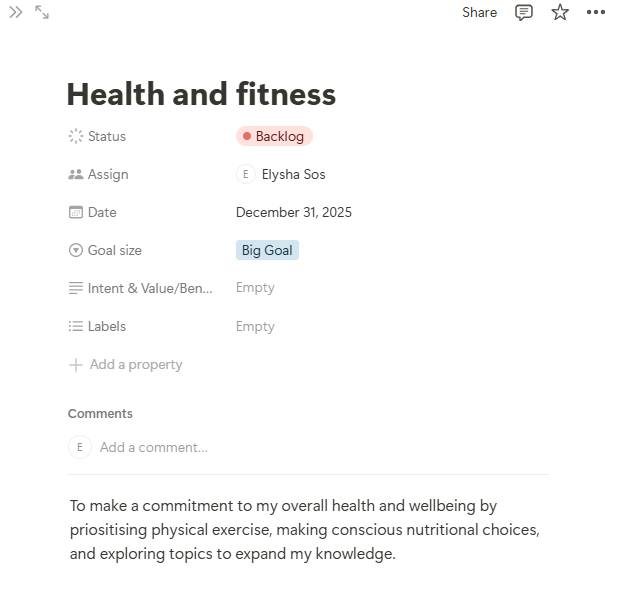
Divide your vision into Big Goals (Epics). These are overarching goals represent the broad priorities that align with your vision.
Big Goals should be categorised into 2-4 areas of your life that will make an impact on your Vision. Think of them as Pillars holding up your Vision for the year. Once you’ve determined the areas most relevant to you and your Vision, you’ll need to decide on the goal in that area you want to achieve and relate it back to your Vision.
Ask yourself:
What do I want to accomplish in this area of my life?
Why is this important to me?
How does my Big Goal help me to achieve my Vision for the year?
Example Big Goals:
- Health and Fitness: Establish habits for physical and mental well-being.
- Family and Kids: Strengthen relationships and create shared experiences.
- Household: Create an organised, stress-free home environment.
- Personal Growth and Finances: Focus on self-improvement and financial stability.
Step 4: Create Focus Goals Within Big Goals

Achievement Timeframe: 1–3 months
As the Vision provides your overall direction, Big Goals give structure, and Focus Goals (Features) break them into actionable areas that should be achieved within 1-3 months (Quarterly goals). These should represent what you believe needs to be focused on to achieve each Big Goal.
The way I see it, Focus Goals are usually the typical “I want to start exercising” – “Get into a better routine” – “Eat Better” or even the simple “I want to lose weight”. They’re general, provide a platform for your pillars, and with consistency would be achieved within the recommended timeframe.
Ask yourself:
What do I need to focus on to complete my Big Goal?
Why is this important to me?
Can I finish this within the next 3 months?
How do I measure my success?
Example Focus Goals:
- Health and Fitness: Build an exercise routine.
- Family and Kids: Establish regular family activities.
- Household: Declutter the house and establish cleaning routines.
- Personal Growth and Finances: Create a savings plan.
Determining Metrics:
How will you know this has been achieved? It’s easy to quantify activities when you’re in a professional setting because you have stats and digital tools available to you. Even though society has mobile phones as an extension to our hands, some activities aren’t as easy to track when it comes to putting a number on something. Here are some suggestions if you’re not able to attach a metric to a number.
- Countable Activities: All metrics are now based on specific counts or activities (e.g., “12 meals” or “2 family activities”) rather than percentages, making it easier to track.
- Time-Based Goals: Goals like “1 hour per week” or “30 minutes weekly” are simple to plan and measure.
- Reflection Instead of Calculations: For areas like health and personal development, a journal or quick notes replace complex tracking, it’s enough to jot down if you felt good or completed the activity.
- For children, the metric could be behaviour related.
- Completion Milestones: For decluttering and home organization, “one area each week” simplifies progress tracking.
Step 5: Create a Quarterly Roadmap
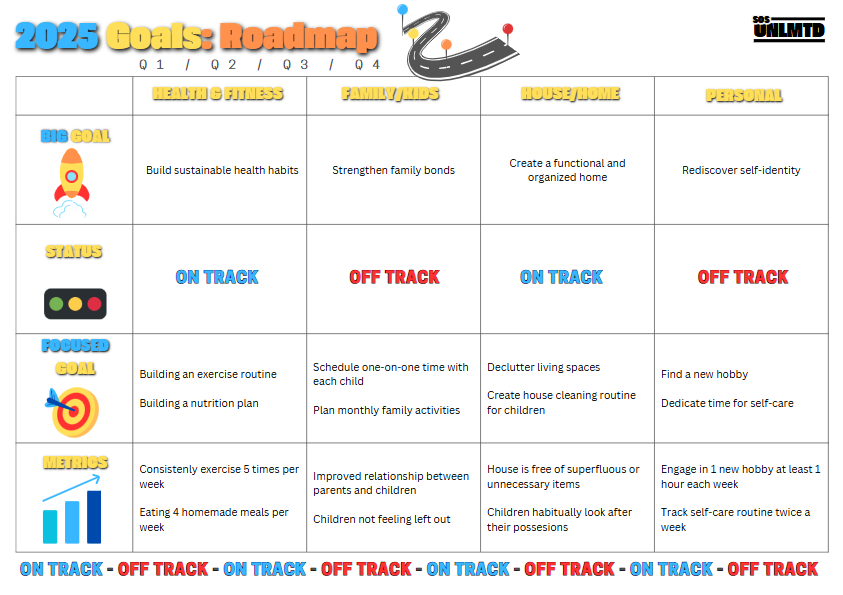
A quarterly roadmap links your Vision to actionable goals, ensuring focus and progress.
Why a Quarterly Roadmap Works:
- It gives you a sense of urgency without feeling overwhelming.
- It provides a checkpoint to assess your progress and adjust.
- It keeps your focus sharp by limiting distractions from other long-term goals.
Step 6: Break Focus Goals Into Actions and Steps
Achievement Timeframe: 1-2 weeks each
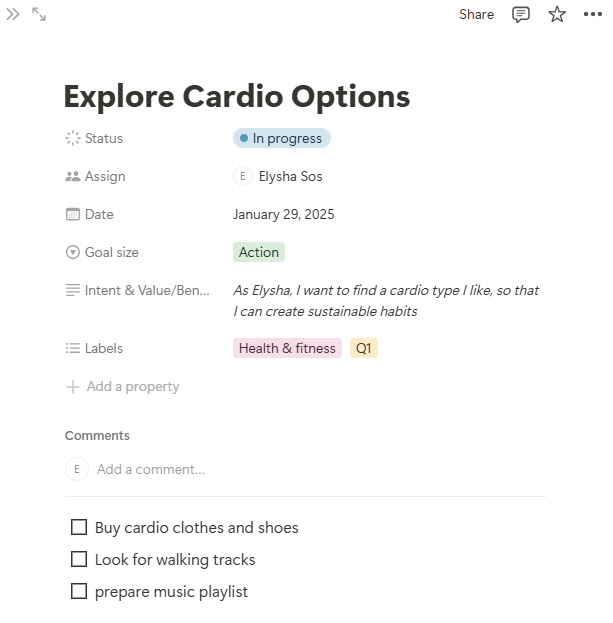
Once you’ve established your Focus Goals, the next step is to translate them into Actions (Stories), specific areas of effort, and Steps, which are the smaller tasks required to complete those actions. These actions should only take between 1-2 weeks to complete and I would recommend having no more than 10-12 Actions at a time. When starting, it’s ok to start small or right at the beginning.
Once all of the Actions created from the Focused Goal have been completed, the Focused Goal is met and you’re ready to assess as to whether your metrics have been achieved.
Example: Health and Fitness
- Big Goal: Health and Fitness
- Focus Goal: Build a Sustainable Exercise Routine
Story: Explore Cardio Options
- Steps:
- Make a list of pros/cons of different cardio options (e.g., walking, running, cycling).
- Look for walking tracks near me.
- Buy comfortable walking clothes and shoes.
Story: Explore Resistance Training
- Steps:
- Sign up for a gym.
- Schedule personal training sessions.
- Create a gym schedule with consistent time slots.
HOT TIP:
When you complete an activity related to any of the goals, actions, or subtasks, I like to add a comment that briefly explains my choices and results that led to completing the activity. This could include screenshots, links, or simply writing what happened. I do this to keep a record of what I’ve done which enables me to reflect and truly see how far I’ve come or any growth I’ve made in that area.
The Why: User Stories in Actions

In a Product team, Stories usually have a section where they create a “User Story“. A User Story is a brief sentence about what you’ll achieve and why it matters. It is structured as: “As a [person/role], I want to [intent], so that [benefit or value].” When creating your Actions, this can help to explain to yourself why you should be doing this action instead of why you think it’s something you should be doing.
Ask yourself:
Who is this Action for?
What do I want to achieve?
What is the overall benefit or value this action offers?
Example:
As Elysha, I want to find a cardio type I like, so that I can create sustainable habits.
Actions are INTENTIONS
Elysha Sos
Step 7: Build Habits and Routines
Habits are the building blocks of achieving goals. Use techniques like habit stacking to integrate new actions into your daily life.
Examples:
- After dropping the children at school, go for a 30 minute walk (habit stacking).
- Block 30 minutes in your calendar for journaling (time-blocking).
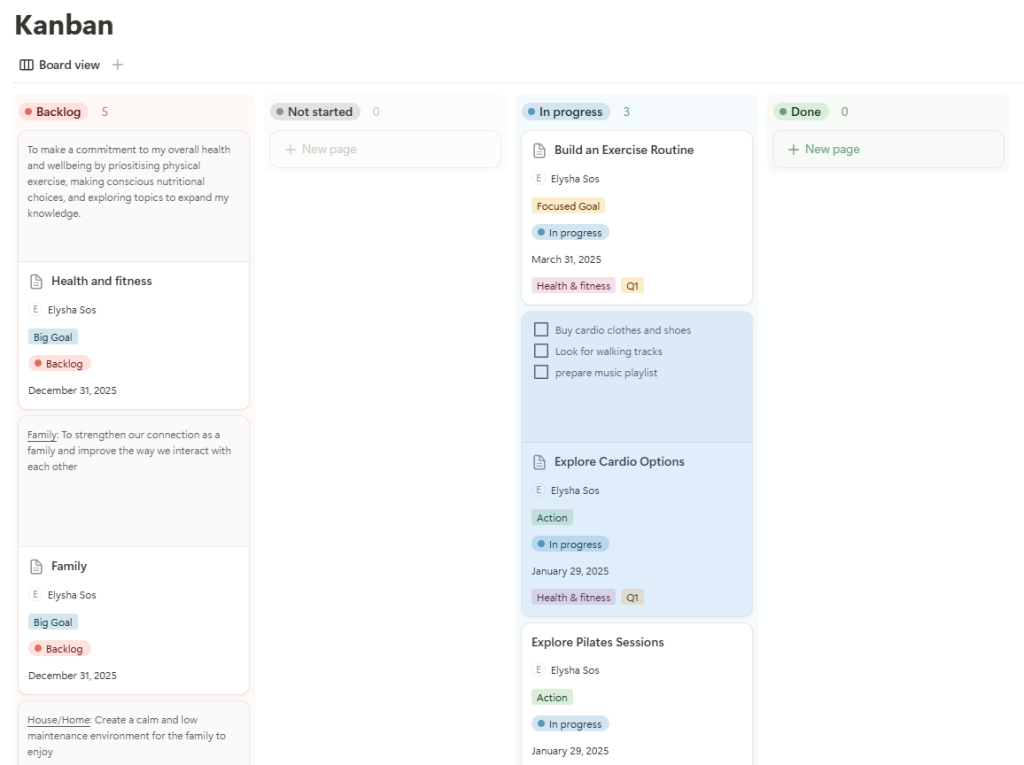
Step 8: Track Progress Using Agile Kanban
Visualise your progress with a Kanban board. Create columns for:
- To Do: Tasks waiting to be started.
- In Progress: Tasks currently being worked on.
- Done: Completed tasks.
Example Kanban for Health and Fitness:
- To Do: Research gyms, buy workout clothes.
- In Progress: Trial a new workout routine.
- Done: Joined a gym, completed three sessions.

Step 9: Reflect, Adapt, and Celebrate Wins
Reflection is essential for growth. ITIL’s “progress iteratively with feedback” principle reminds us to refine our approach regularly.
Quarterly Reflection Prompts:
- What worked well?
- What didn’t work?
- What adjustments can I make for the next quarter?
Celebrate Small Wins:
Acknowledge milestones to stay motivated.
- Example: Reward yourself with a spa day after completing 12 workouts or treat yourself to a new book after decluttering the pantry.
Overcoming Common Obstacles
Even with the best frameworks, life happens. Here’s how to handle some common challenges:
- Falling Behind:
Reassess your roadmap and adjust your goals. Life is iterative—don’t let perfectionism hold you back. - Lack of Motivation:
Break your tasks into smaller steps and focus on the easiest one to build momentum. - Feeling Overwhelmed:
Use the Quick Start Guide and focus on just one epic at a time.
How to Set Up Your Goals: Digital, Notebook, or Whiteboard?
Now that you know which frameworks to use, the real magic happens when you set up a system that works for YOU. Whether it’s digital, a good old notebook, or a whiteboard, creating a system you can track and update is key to making this all come together.
1. Digital Tools
If you love tech, digital tools are a fantastic way to stay on top of your goals.
- Trello: Create a Kanban board to visually track your progress.
- Notion: A versatile tool for tracking goals, notes, and milestones.
- Habitica: Gamify your progress with rewards for hitting milestones.
- Google Calendar/Tasks: Schedule your tasks and set reminders to keep you on track.
Using digital tools brings everything into one place, making it easy to manage and access your goals wherever you are. You can’t beat the convenience of having everything sync across your devices.
2. Using a Notebook
If you love the tactile feel of pen and paper, a notebook can help you set goals while keeping it simple.
- How to Use It: Dedicate pages to each Epic, break them down into Stories and Tasks, and use checkboxes to monitor progress.
There’s something satisfying about crossing off tasks in a notebook. It turns the goal-setting process into a fun, rewarding experience that digital tools can’t replicate. Not to mention the power of physically putting your goals into the universe has a profound impact on achieving them.
3. Whiteboard or Corkboard
For the visual thinkers, a whiteboard or corkboard can be a game-changer.
- How to Use It: Write down your tasks and move them through columns as you progress. Add motivational visuals or quotes to inspire you.
Seeing your tasks move from “To Do” to “Done” on a big board in front of you creates tangible, visible momentum. You’ll be amazed at how motivating it can be!
By choosing a method that aligns with your habits and preferences, you can stay organised, focused, and motivated throughout the year. Whether it’s digital, a notebook, or a whiteboard, your goal-tracking system will become the backbone of your success in 2025.
Final Thoughts
This refined framework combines personal insights with professional structure, allowing you to achieve goals with clarity and purpose. By breaking your vision into manageable steps, you’ll create a roadmap that not only motivates but also adapts to life’s challenges.
Remember, your journey is uniquely yours. Revisit your framework regularly, whether at the end of a quarter, a challenging week, or even after a major milestone. Reflection and adjustment are not signs of failure but of growth and resilience.
You’ve already taken the most important step by envisioning a better version of your life. Now it’s time to build it, step by step. Trust the process, celebrate the small wins, and keep moving forward.
Start small with the Quick Start Guide, and when you’re ready, dive into the comprehensive framework. Your goals are within reach, you just need a system to get there.
Your goals are within reach, you just need a system to get there. Start today, and by this time next year, you’ll be amazed at what you’ve achieved.
What’s your vision for this year? Share it in the comments, and let’s inspire and support each other along the way!
As always, thank you for being here!
Elysha