
Speech and Language Development Tips
Our first session with the Speech and Language Therapist started by getting to know where Nasir was at with his language; how he communicated, words he knew, what he struggles with, and anything that I had tried. This helped to determine where to begin and what strategies to use to kick off the journey of Nasirs speech and cognitive development. I was put at ease and felt hopeful that these new tools would bring positive outcomes for Nasir and I to be able to communicate better.
I had tried ineffective tips on mum groups in which other mums would encourage their children to “use their words”. The advice I saw was basically if their kid wanted something then they would have to say a chosen word, like “cup” or “drink”, before the parent would give it to them. When I did this, I’d get super frustrated that Nasir just wasn’t “getting it” then he would also get upset that he wasn’t getting whatever I was withholding. It’s safe to say that I didn’t continue with this fruitless exercise.
Tools Before Speech and Language Therapist Engagement.
I didn’t fully realise the impacts of what were already doing with Nasir. Yes, the delays were there, and we weren’t aware how delayed he was, but we were on the right path.
Nasir has always loved books; he really enjoyed the phonics books I had bought for him. They were of classic stories, nursery rhymes, and fairy tales that rhymed and highlighted the sounds the book focused on. We never paid much attention to the phonics emphasis of these books because we were quite theatric on how we read them. He would also get to choose the books which helped him engage more in the story. To encourage him we would animate the experience by:
Books were a normal part of our bedtime routine, but after this we would sing the same songs:
In fact, music in general has always been prevalent in our house and once we get hooked on a song, it’s constantly played. Bonus if it has a kickass music video! We would have a lot of dance parties which included… DANCE! Duh! Though Nasir had started imitating the actions or movements that were being acted out in the video as well. I remember he taught himself the Toosie Slide.
And there was the obvious engagement in conversations with him, from what we could understand. It doesn’t seem like it’s much because it’s all so simple, but I didn’t realise that from these basic engagements, there is lots of fundamental speech and language development happening:
- Phonological Awareness: Exposed to the rhythm and sound patterns of language. Rhyming stories and nursery rhymes helped him recognize the sounds within words, an essential pre-reading skill.
- Vocabulary Development: Exposed to new words and phrases. The act of discussing the pictures in the books further expanded his understanding of word meanings and storytelling.
- Engagement and Listening Comprehension: Allowing Nasir to choose the books and act out the stories with voices and actions kept him engaged, improving his listening comprehension and ability to follow narratives.
- Expressive Language Skills: Using different voices (high, deep, loud, quiet) helped Nasir understand tone and expression, which are important for conveying emotions and intent in language.
- Music and Rhythm: Singing familiar songs after reading reinforced language patterns and rhythm. Nasir’s exposure to songs like “Over the Rainbow” and “Twinkle, Twinkle Little Star” strengthened his ability to follow sequences in language and remember lyrics.
- Imitation and Action-based Learning: Watching music videos and dancing encouraged Nasir to imitate actions, which not only enhances motor coordination but also supports imitation in speech and language, as children often mimic words, phrases, and expressions they observe.
Commenting.
Our therapist gave us direction, accountability, and understanding how the how’s, why’s, when’s, and where’s. She broke it down so I could understand where to support Nasir and how to tweak my interactions to connect how it matters. This is gold when you’re working with a little one that struggles with communication because although I felt engaged with Nasir when reading or singing with him, we started making real progress when I started getting on his level and modeling language effectively.
After discussing the basics and how to communicate when you don’t understand your child, I was asked to choose a task to focus on for the coming month from the top tips. I selected “commenting” for Nasir and I. This is a quick video that was shared with me on how to execute this although I tweaked it to suit Nasir’s level of comprehension.
We were sent off for the next month to work on the commenting and was asked to take videos of putting it into practice so she could review how to make it more effective. The Speech and Language Therapist called out what she noticed which was encouraging because she kept it positive even when she was suggesting how I could help him more. I don’t know if you’ve ever received feedback but for me, it has much more of an impact when presented in a gentle and empowering manner as opposed to getting a “this isn’t good enough” vibe. In some reverse psychology kind of way, she’s modeling the behaviour I should be showing to all of my children. I appreciate that.
From those short videos, it looks like lots of things are going really well. In particular I noticed how you were down at his level, repeating words over again in different sentences, recasting or modelling his words and sentences back to him with correct pronunciation, taking turns with him in the interaction, and using more comments than questions.
Ministry of Education Speech and Language Therapist
Something else we talked about this morning was following what Nasir is interested in moment by moment since he can have quite a short attention span. If he moves his focus onto something else, you can abandon what you were talking about and make a comment about whatever he has moved on to.
I remembered another strategy which I have copied here from the Hanen website. If Nasir initiates talking about something he can see, it can be easier to make sure you’re focused on the same thing, e.g. if he starts talking about the mouse button to try and get you to turn the TV on, you can make a comment about that, “push the button to make it go”.
Observe, Wait and Listen (OWL)
This is the additional strategy as mentioned above. I feel it deserves its own section.
- Observe what your child is interested in – it can be helpful to get face to face with your child to see exactly what has captured her attention (e.g., the playdough is stuck inside of the cookie cutter) and to show that you’re interested in what she’s doing.
- Wait (without talking) for your child to send you a message. Some parents find it helpful to silently count to five before talking.
- Listen for any way that your child sends you messages (e.g., she might make a sound, say a word and/or show you the cookie cutter).
When you Observe, Wait and Listen to your child’s messages, you let her start the interaction and lead it! Children are motivated to interact when you’re talking about their interests, and they get to lead the interaction.
Go to The Power of Waiting: The Key to Supporting Your Child’s Communication (hanen.org) for more information on this.
When You Can’t Understand Your Child.
Supry is an involved dad, but because I was spending more time with Nasir, whether that was working on his language or otherwise, I was forever being the translator for Supry to help him understand Nasirs needs if he was trying to express them verbally. He was great with physical interpretation; Nasir takes you to the fridge and points to a drink, obviously the boy wants a drink. It’s hard for just one parent to help their child when the other is getting frustrated that they aren’t at the same comprehension level. When I expressed this to our Speech and Language Therapist, she sent through some helpful information on how Supry could work synergistically with both Nasir and I to keep the momentum going.
- Get down to your child’s level so you are face-to-face. Crouch or sit down if you need to, to be at eye level.
- Reassure your child that you want to understand what they are saying.
- Take some of the responsibility for the communication problem (e.g. “It’s really noisy in here. I couldn’t hear. Can you tell me again?” or “Sorry, my ears aren’t working very well today.”)
- Be honest. Don’t pretend to understand, if you don’t.
- Repeat back the parts of the message that you did understand (e.g. “You went to the park, and what happened?”).
- Encourage your child to show you (with gestures, pointing, pictures) what they want to tell you.
- Try to clarify the topic (e.g. “Are we still talking about swimming?”).
Sometimes, despite trying all the suggestions above, you might not be able to figure out what your child is saying. Acknowledge that you still want to know what they said, and that you will try again later (e.g. “This is really tricky, isn’t it. You’re working hard to tell me. Let’s take a break and we can try again later.”)
Speech and Language Development Strategies.
The top tips and advice offered to us that has made a huge difference with how we engage with and support Nasir’s speech and language communication.


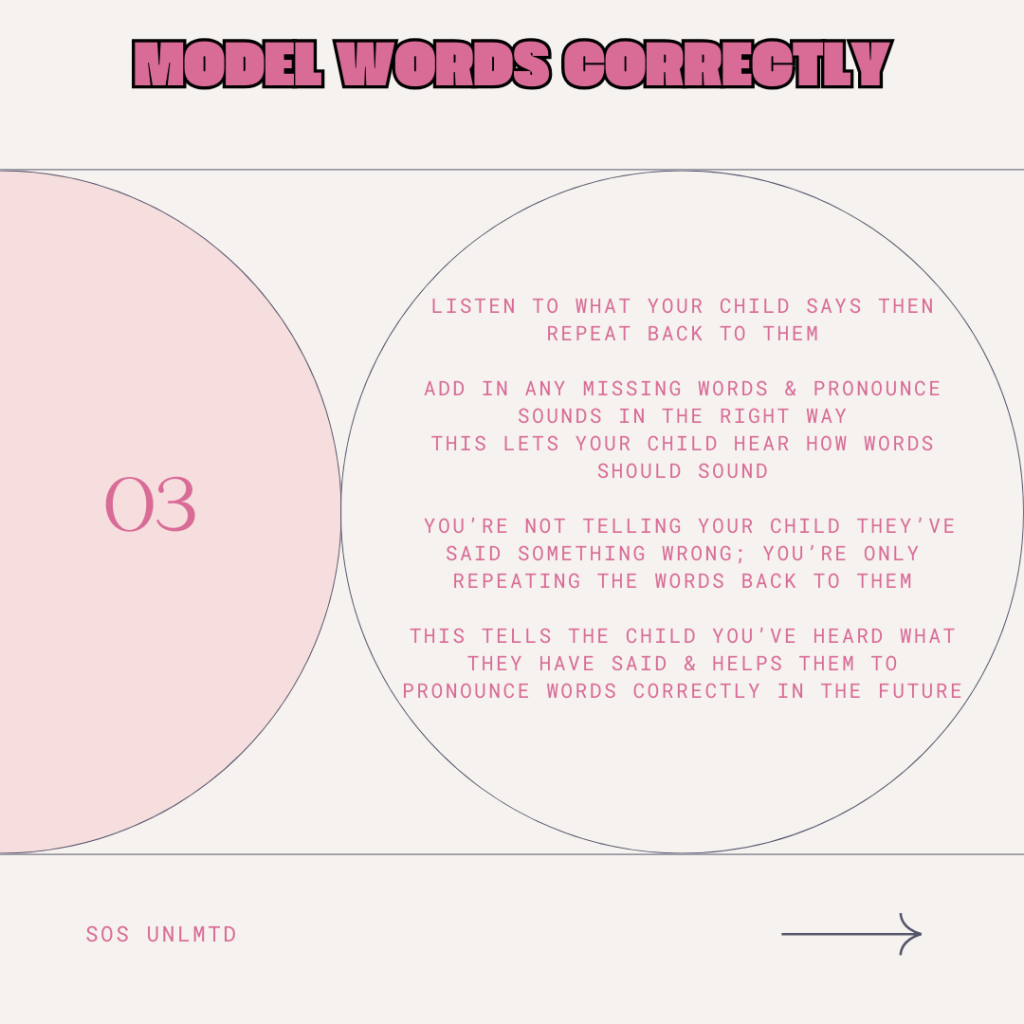


The GAME CHANGERS That Helped Nasir.
It’s been a long road but as I reflect on the basics shared in this first meeting, I realise that these simple strategies have become a natural part of my daily communication with Nasir as they were so easy to implement. Another great point about this guidance is that as we got further along with the therapy, not only Rahim would want to be involved (maybe that’s why he’s so cheeky) but Nasir would also be receptive when teaching Rahim certain words or phrases. We got really good at reading his physical communication; I mean, how else were we supposed to toilet train him?! But his world transformed when his verbal communication progressed.
The advice I’ve received from the first two sessions have remained some of the strongest and most effective strategies that have deepened my ability to communicate well with Nasir. Our most used strategies have been:
Modeling / Remodeling / Narrating.
I hadn’t realised I was doing this until my cousin pointed out that I do it so naturally. That’s how easy it was to get into the habit of putting it into practice. I have been floored with just how well this has improved the way he pronounces or adds in words to his sentences. Narrating actions or routines is one of the recommendations to develop babies’ language, so when you think about it, it should be one of the basics to implement or keep going even with older children. Especially if you’re a creature of habit, that repetition is going to be.. repetitive! Whenever Nasir starts communicating with me, I do the following:
- Put down what I’m doing and make eye contact
- Clearly repeat what I understood he has said in a complete sentence
- Reply with a comment or a follow up question
- Continue until he’s finished
Clarifying Nasir’s Communication.
Hah! This one gives me flashbacks to being in IT Problem Management. It was just a whole bunch of clarifying questions and statements to identify root cause. Communication with a speech delayed child is no different. Nasir for most of his life spoke in what can only be described as Gibberish and not the made-up Gibberish from when I was a child in the 90’s. No, this is unintelligible, no code, and definitely not made-up. As his language has developed and his vocabulary has widened, this Gibberish has become less but we still experience it daily as he is trying to find the words that go with what he is saying. To understand what he is saying in the situation, I:
- Ask him to repeat what he has said
- Model or remodel what I think I have heard
- He will do his best to correct me
- If he cannot correct me verbally, he will try to show me
- I will ask “Do you mean _?” then clarify the entire sentence again to match what he is attempting to say
Positive Reinforcement.
Who doesn’t love to be hyped and told they’re awesome?! Needing no explanation but I’ll do it anyway. We clap, say YAY YOU DID IT, get excited, tell him what he did well! He loves it. I mean, maybe in his mind he’s thinking “Yes, I’m amazing, but all I did/said was this… Nothing special mate, I do/say this all the time”. Am I projecting, yes! But I really wish I could spend a day in his mind. In all the kids minds, actually, that would be fun!
Emersing In Nasir’s Interests.
If he likes it, it’s EVERYWHERE! We get the clothes, the toys, the apps, the YouTube channels, take it to school, make it out of playdough, play the music in the car, we buy the books! We do it all! Not just for Nasir but for Rahim and Aisha too… and Supry for that matter. Our house is a collection of Marvel Superheroes, Disney Princesses, My Singing Robots, Minecraft, Rainbow Friends, Transformers, Rainbows, and all of the weird and wonderful things we all love.
It feels to me that this is all about repetition, if it’s everywhere the words develop then they get easier to say and the pronunciation gets mastered. If we know what it is that he is talking about or a particular word he is trying to use he will feel good and confident. Don’t get me wrong, he has no problem with correcting us but as a mother to 3 children and a husband, IT’S NICE TO BE HEARD THE FIRST DAMN TIME!
Until The Next One…
The journey of Nasir’s speech and language development has been a transformative experience, not only for Nasir but also for me. We’ve had plenty of trial and error and moments of frustration but it’s been extremely rewarding. Engaging the guidance of a Speech and Language Therapist truly made the difference, helping us shift from well-meaning but ineffective strategies to techniques that really worked. The foundational tools we’ve learned have allowed us to better understand and support him, turning everyday moments into opportunities for growth. It’s been incredible to witness Nasir’s confidence soar as his communication skills develop, and I feel more equipped as a parent to help him continue on this path.
I hope these tips and our experience with them encourage and empower other parents to go back to basics and give themselves grace in what can feel like a heartbreaking or frustrating journey. Having a Speech and Language Therapist can help work strategies, tools, and even reassurance into your own situation. I know for Ministry Therapist, the waitlist is long, but perhaps in the meantime, a little bit of this coupled with Ms. Rachel can help to get you underway.
Thanks for getting this far!
Elysha